
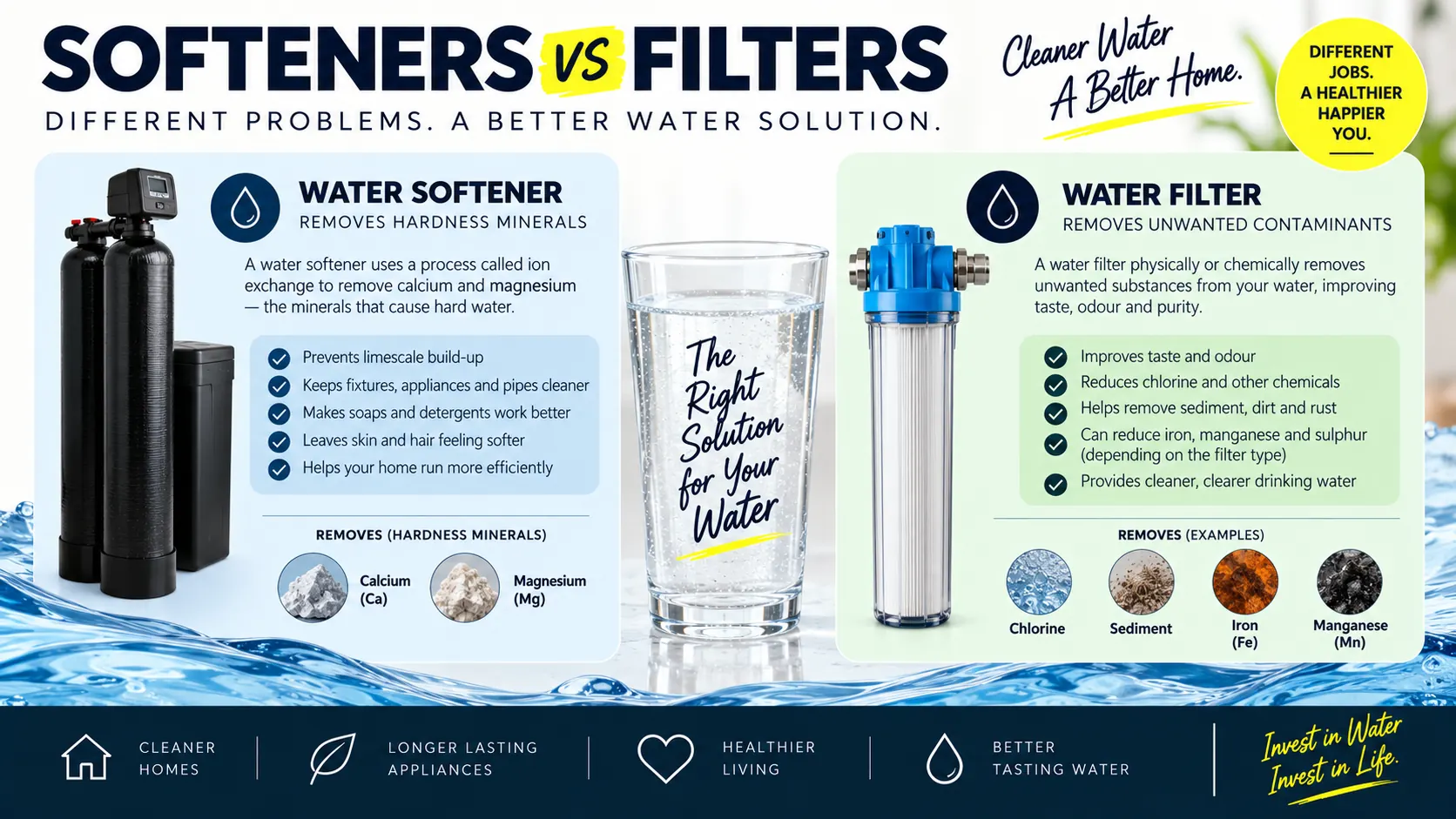
What whole-home filtration is
A point-of-entry filter treats water before it branches to most fixtures. “Whole-home filter” describes where it sits, not what it removes. Sediment cartridges, backwashing media tanks and activated carbon have different targets, flow limits and maintenance needs.
What filtration is not
A filter is not automatically a softener, disinfectant or universal contaminant barrier. Broad claims such as “cleaner water” are not enough; define the target and check the exact model’s documented reduction claim.
Sediment filtration
Sediment filters capture particles within a stated micron range. Smaller is not always better: finer media can load quickly and create pressure loss. Well yield, particle size and dirt-holding capacity guide whether to use cartridges, spin-down separation or backwashing filtration.
Carbon and other media
Activated carbon is widely used for specified taste, odor and chlorine-related aesthetic claims. Chloramine reduction requires equipment specifically tested and sized for chloramine; do not assume every carbon tank performs identically. Other media may target iron, manganese, acidity or specific substances, but chemistry and operating conditions determine suitability.
Flow rate and pressure drop
A whole-home system must pass the home’s busy-time flow. Housing size, media bed, valve, cartridge condition and pipe diameter all influence pressure drop. Compare rated service flow at a meaningful pressure loss, not a marketing maximum.
Media life and maintenance
Replacement intervals depend on gallons treated, contaminant load and breakthrough—not only elapsed months. Track pressure, taste or odor changes and manufacturer limits. Backwashing systems also need adequate drain flow and programming.
Point-of-entry vs point-of-use
Whole-home treatment protects many fixtures and supplies showers and laundry. Point-of-use systems treat one faucet and can be more efficient for a drinking-water goal. Reverse osmosis is a common point-of-use option.
Combining a filter and softener
Where both are justified, treatment order depends on the target and equipment. Sediment or oxidized metals may need attention before a softener; carbon placement depends on design and resin protection goals. Do not copy a universal diagram without testing.
City and well applications
City-water homeowners may focus on documented aesthetic preferences while recognizing public reporting. Well-water filtration must start with sampling because sediment, iron, manganese, sulfur odor, pH and microbiological concerns require different responses.
Certification and proof
NSF/ANSI 42 covers specified aesthetic claims, while NSF/ANSI 53 covers specified health-effect reduction claims. Certification to a standard is not certification to remove everything. Verify the exact model and claim in a certifier’s listing.
Common questions
Does a water filter soften water?
Typical sediment and carbon filters do not remove calcium and magnesium hardness.
Will carbon remove chloramine?
Only rely on a model with a documented chloramine claim and adequate contact time for the intended flow.
Why did pressure drop after installation?
The filter may be undersized, loaded, too fine or paired with restrictive plumbing.
Can one filter treat well water?
Sometimes one target needs one process, but many wells require a staged plan based on results.
Sources matched to this guide
NSF residential treatment standards guide; City of North Port Water Quality
Sources support the specific factual statements above. Equipment claims still depend on the exact certified model and local conditions.