
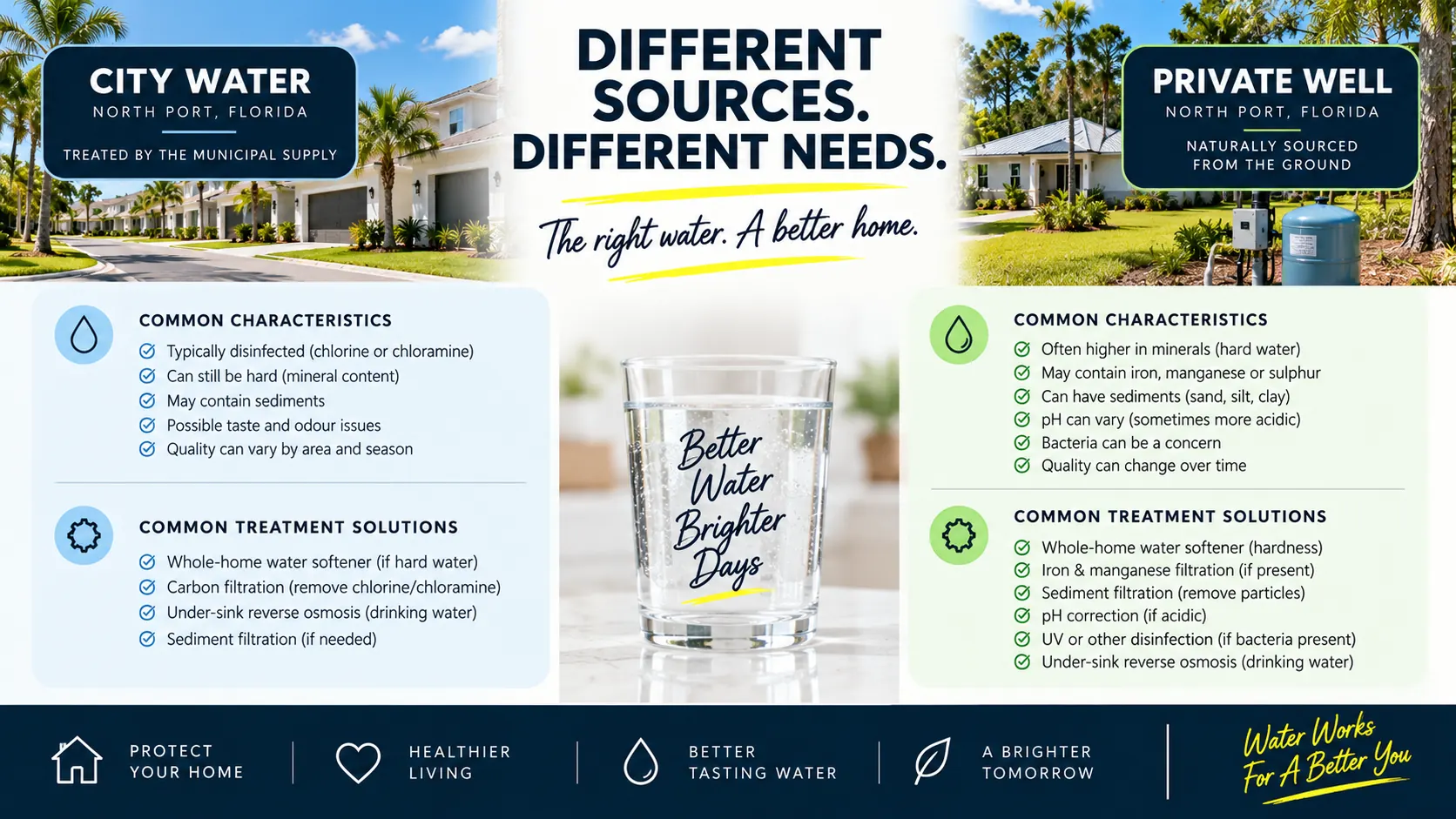
What is the difference between city water and well water?
A public utility treats, monitors and reports water delivered through its system. A private-well owner manages the source, equipment, testing and response to changing conditions. Household plumbing still affects both.
City-water evidence
Use the current CCR for regulated system results and source information. A home test answers narrower questions such as hardness at the tap or whether building plumbing affects a sample.
Private-well evidence
A well needs a property-specific testing plan. EPA advises annual baseline testing and additional sampling after changes, repairs, flooding or suspected contamination.
Treatment priorities
City customers often investigate hardness, scale or aesthetic preferences. Well owners may also need to evaluate iron, manganese, pH, sediment, sulfur odor and microbiological parameters. None should be assumed present.
Who maintains what
The utility is responsible for the public system; the property owner remains responsible for private plumbing and optional treatment. A well owner is responsible from source through household delivery.
The useful first step
Identify the source, separate a safety question from an aesthetic preference, gather the relevant report or test, then select treatment for the documented target.
Common questions
Is well water automatically unsafe?
No, but safety cannot be assumed from appearance. Well owners need appropriate testing.
Does City reporting cover my well?
No. A CCR applies to the public system named in the report.
Can both sources be hard?
Yes. Hardness is possible in either, and should be measured at the property.
Sources matched to this guide
City of North Port Water Quality; EPA private-well guidance
Sources support the specific factual statements above. Equipment claims still depend on the exact certified model and local conditions.